
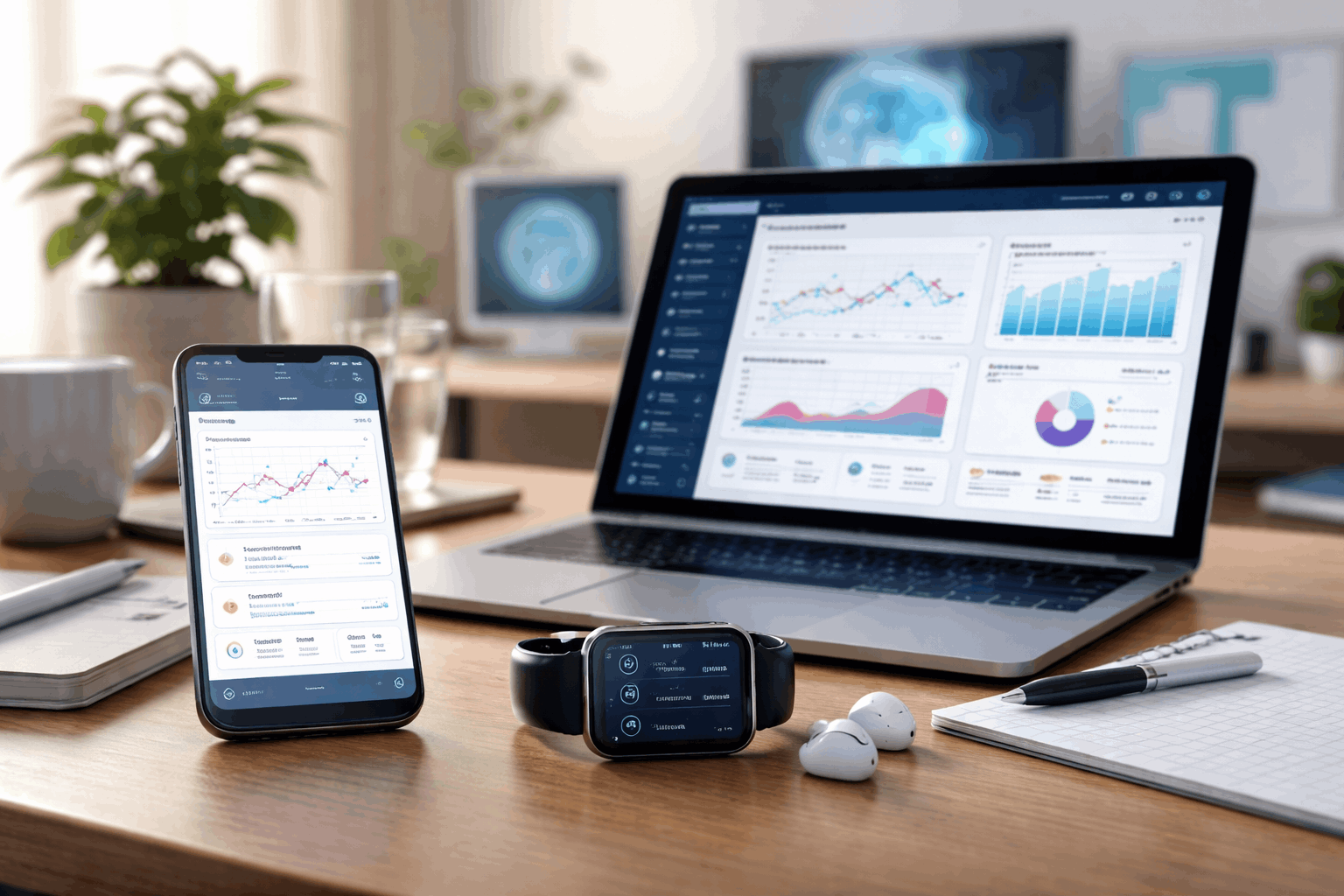
Digital behavioral assessments use smartphones, wearables, and online tools to measure patterns related to mood, cognition, and daily functioning.
AI systems analyze these data streams to detect trends, flag changes, and summarize information for clinicians.
Leading health organizations emphasize that such tools should support, not replace, professional judgment.
What Digital Behavioral Assessments Are
Digital behavioral assessments refer to technology-enabled methods that capture psychological and behavioral data in real time or near real time.
They often combine brief self-reports with passive data such as movement, device use, or sleep-related signals.
Research in digital mental health shows these approaches can reveal variability that single clinic visits may miss.
However, they are considered complementary tools rather than standalone diagnostic systems.
Ecological Momentary Assessment
Ecological momentary assessment uses short prompts delivered during daily life to reduce recall bias.
Studies published in journals such as the Journal of Medical Internet Research report improved symptom tracking through repeated brief check-ins.
AI can aggregate these entries into trend summaries that support measurement-based care.
Passive Smartphone Sensing
Passive sensing collects data such as activity levels or device interaction patterns without requiring manual input.
The concept of digital phenotyping, described in peer-reviewed literature, focuses on translating these signals into behavioral indicators.
Researchers caution that interpretation requires careful validation because context strongly shapes behavior data.

Key AI Methods Used
AI in digital behavioral assessment commonly relies on machine learning models trained on labeled symptom data.
These models identify relationships between digital signals and outcomes such as depression severity scores.
Performance depends on representative training data and transparent validation procedures.
Health authorities stress that probabilistic outputs must be communicated clearly to avoid overstating certainty.
Natural Language Processing
Natural language processing analyzes written or spoken text to detect patterns such as sentiment or linguistic shifts.
Mental health research suggests that certain language features may correlate with stress or mood changes.
Because language data are sensitive, privacy safeguards and consent procedures are essential.
Sensor-Based Predictive Modeling
Sensor-based modeling examines patterns in movement, sleep timing, and routine stability.
Studies indicate associations between disrupted daily rhythms and depressive symptoms.
Outputs are typically framed as risk indicators rather than diagnostic conclusions.
Common Data Sources in Practice
Digital behavioral tools integrate both active and passive data streams.
Active data include self-reported mood ratings or structured symptom questionnaires.
Passive data include accelerometer readings, screen usage duration, and wearable sleep metrics.
Combining multiple sources can improve robustness compared to relying on a single metric.
Wearables and Activity Tracking
Wearables provide step counts, heart rate trends, and sleep-related estimates.
Systematic reviews note moderate associations between these signals and mental health states.
Consistency and device standardization remain important research challenges.
Communication and Interaction Patterns
Some research explores how messaging frequency or response timing relates to social withdrawal.
These measures are treated cautiously because communication styles differ widely across individuals.
Ethical guidance emphasizes transparency about what is monitored and why.
Clinical Uses and Limits
Clinicians often use digital assessments for symptom monitoring between appointments.
Measurement-based care models benefit from structured longitudinal data. Early detection of worsening patterns may support timely outreach.
At the same time, false positives and overinterpretation remain ongoing concerns.
Screening Support
Digital tools can assist in screening by highlighting meaningful score changes over time.
Peer-reviewed studies report moderate predictive accuracy for some conditions under controlled settings.
Screening decisions still require clinician review and patient discussion.
Treatment Monitoring
AI-generated summaries can support therapy sessions by visualizing sleep or mood trends.
Researchers are investigating relapse prediction models, though generalizability remains limited.
Professional responsibility stays with the clinician, not the algorithm.
Validity, Bias, and Safety
Validity extends beyond statistical accuracy to include clinical relevance and fairness.
Bias may arise if training datasets underrepresent certain demographic groups.
International guidance from organizations such as the World Health Organization calls for equity-focused evaluation.
Ongoing monitoring and transparent reporting are considered best practice.
Generalizability
Models developed in research cohorts may not perform equally well in community settings.
External validation studies are therefore critical before wide deployment.
Documentation of limitations strengthens responsible implementation.
Explainability and Accountability
Clinicians must understand how a tool generated a risk signal.
Regulatory guidance from agencies like the U.S. Food and Drug Administration highlights transparency in clinical decision support software.
Clear documentation ensures accountability when digital tools influence care.
Privacy and Governance
Digital behavioral data can reveal highly personal routines and social patterns.
Strong data governance includes consent clarity, encryption, and minimal data retention.
The American Psychiatric Association’s app evaluation framework encourages structured privacy review.
Patients should be able to understand and control how their information is used.
App Evaluation Models
Professional frameworks recommend assessing access, evidence, privacy, and usability before clinical use.
These models help clinicians evaluate whether benefits outweigh potential risks.
Structured evaluation supports safer integration into practice.
Regulatory Considerations
Some AI-enabled mental health tools fall under medical device regulations depending on their function.
Regulators distinguish between supportive decision tools and autonomous diagnostic systems.
Clear labeling of intended use reduces confusion about clinical responsibility.
Practical Implementation Considerations
Organizations are advised to start with limited, well-defined use cases such as symptom tracking.
Workflow planning should clarify who reviews data and how alerts are handled.
Training clinicians and informing patients improves transparency and trust.
Patient-centered communication remains central to ethical digital assessment.
List of Digital Behavioral Assessments
Here is a clear, research-aligned list of digital behavioral assessments commonly discussed in psychology and digital mental health literature:
- Ecological Momentary Assessment (EMA) – Repeated short mood or symptom check-ins delivered via smartphone throughout the day.
- Digital Phenotyping – Continuous collection of smartphone sensor data (movement, screen use, location patterns) to infer behavioral trends.
- Wearable Activity Monitoring – Use of fitness trackers or smartwatches to assess sleep patterns, step counts, and physiological proxies.
- Mobile Mood Tracking Apps – Daily or weekly self-report mood rating tools with trend visualization.
- Computerized Cognitive Testing – Digital tasks assessing attention, memory, processing speed, or executive functioning.
- Natural Language Processing (NLP) Text Analysis – AI analysis of written journals, chat messages, or speech transcripts for sentiment and linguistic markers.
- Voice and Speech Pattern Analysis – Acoustic feature modeling (tone, speed, pauses) associated with mood or stress levels.
- Online Behavioral Questionnaires with AI Scoring – Digitized clinical scales with automated scoring and change detection.
Conclusion
Digital behavioral assessments powered by AI represent a growing area within psychology and mental health research.
Peer-reviewed studies and international guidelines highlight both potential benefits and important limitations.
When implemented with evidence, fairness, and strong governance, these tools can complement traditional care.